Australian stone fruit production is projected to decline in marketing year (MY) 2025/26, mainly due to the Bureau of Meteorology's forecast of wetter-than-average spring conditions. If realized, the wetter season is expected to lower yields and fruit quality.
Cherry production is forecast at 18,000 metric tons (MT), down 10 percent from MY 2024/25, with exports projected at 4,000 MT, a 9 percent decrease. Peach and nectarine production is forecast at 70,000 MT, down 7 percent, with exports at 11,200 MT, also 7 percent lower. Domestic consumption of cherries is projected at 15,500 MT, while peaches and nectarines are forecast at 59,300 MT. Imports, primarily from the United States, are expected to rise slightly, with cherries forecast at 1,500 MT and peaches/nectarines at 800 MT.
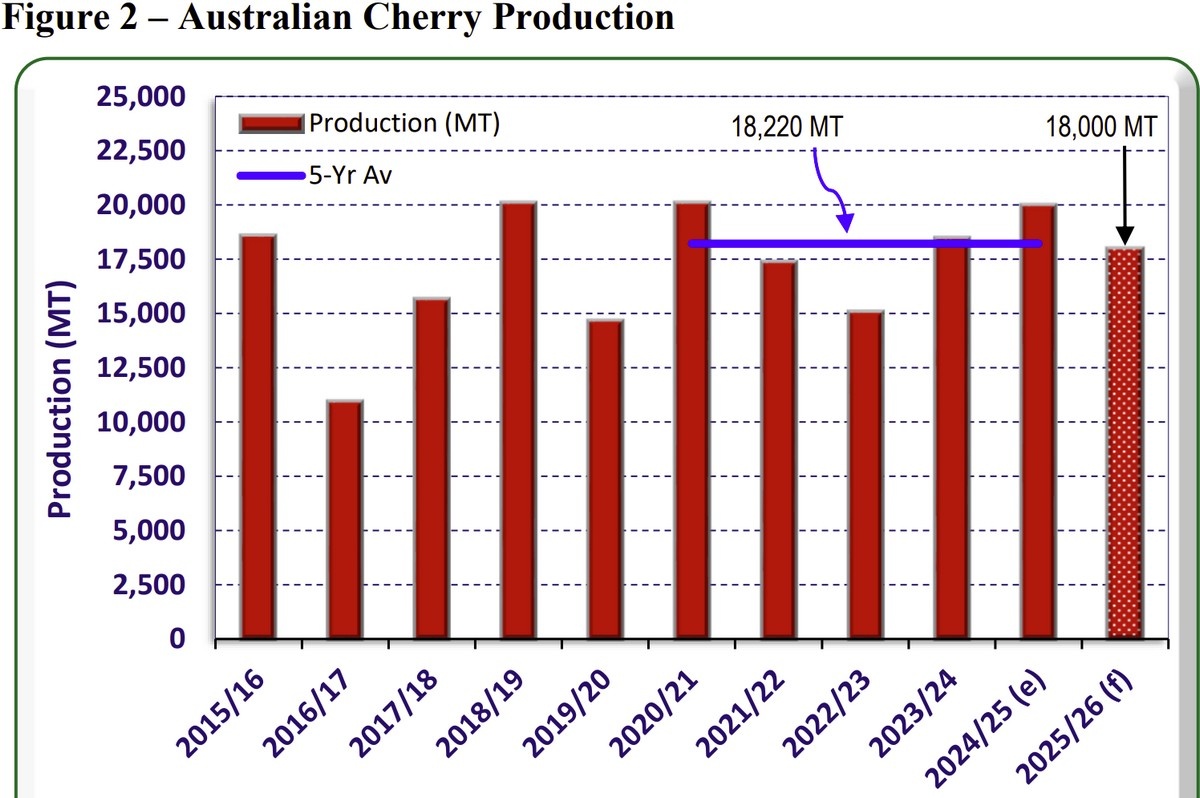 © PSD online and FAS/Canberra estimates and forecasts
Tasmania is forecast to have average rainfall, supporting potential for good export quality, while New South Wales, South Australia, and Victoria face higher rainfall risks during harvest that could lead to fruit splitting and reduced shelf life.
For peaches and nectarines, Victoria continues to dominate production with the Goulburn Valley and Sunraysia as key regions. Water availability in irrigated areas is expected to be lower, but increased spring rainfall may improve allocations. Industry sources note that planted area has declined in recent years, with no major expansion expected.
Trade data show that China, Singapore, the United Arab Emirates, and Hong Kong remain primary destinations for both cherries and nectarines. However, a shift has been noted with Singapore and the UAE increasing their share as exports to China decline. Nectarines continue to represent around two-thirds of total exports, with firmer flesh making them more suitable for sea freight.
On imports, Australia's major supermarket chains remain reluctant to reintroduce U.S. peaches and nectarines after a suspension in MY 2023/24, but quality reports from MY 2024/25 have been favorable. This season, imports of peaches and nectarines are estimated at 600 MT, with the MY 2025/26 forecast at 800 MT.
Overall, MY 2025/26 forecasts reflect favorable early chill conditions but risks from forecast spring rainfall across most production areas, with Tasmania better positioned compared to other states.
To view the full report, click here.
 For more information:
USDA
Tel: +1 (202) 720-2791
Email: [email protected]
www.usda.gov