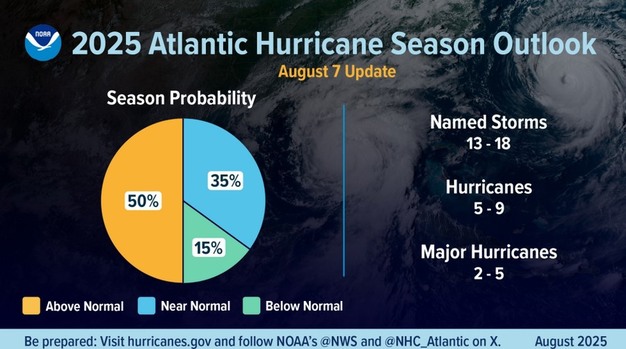
The National Oceanic and Atmospheric Administration (NOAA) continues to project an above-normal Atlantic hurricane season. On August 7, NOAA updated its forecast to 13 to 18 named storms with winds of 39 mph or greater for the period from June 1 to November 30. Of these, five to nine could develop into hurricanes with winds of 74 mph or greater, including two to five major hurricanes with winds of 111 mph or greater.
In a typical Atlantic hurricane season, the basin averages 14 named storms, seven hurricanes, and three major hurricanes. NOAA currently assigns a 50% likelihood to above-normal activity, a 35% chance of a near-normal season, and a 15% chance of a below-normal season. The updated forecast remains in line with the initial outlook issued in May.
 © NOAA
Tropical Storm Chantal made the first U.S. landfall of the season over the Independence Day weekend, bringing high winds and flooding to the Carolinas.
According to NOAA, elevated tropical storm activity in the Atlantic basin this season is expected due to warmer-than-average sea surface temperatures in the tropical Atlantic Ocean and Caribbean Sea, as well as an active West African Monsoon. Neutral El Niño-Southern Oscillation conditions are forecast to persist, meaning there is neither an El Niño nor a La Niña phase influencing storm formation.
"Many of the factors we identified ahead of the season are still at play, and conditions are largely tracking along with our May predictions," said Matt Rosencrans, lead hurricane season forecaster with NOAA's National Centers for Environmental Prediction.
Source: Citrus Industry