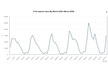
The country’s external trade in agricultural commodities in the second quarter grew 2.6 percent to $4.011 billion, from $3.910 billion during the same period last year, according to the Philippine Statistics Authority (PSA).
As a result, the country’s agricultural trade deficit in the April-to-June period shrank 23.76 percent to $1.335 billion, against the $1.751- billion deficit recorded in the same period in 2016.
The PSA attributed the improvement in the Philippines agricultural trade to the higher agricultural commodities the Philippines exported and lower imports during the three-month period.
“Agricultural export expanded by 23.9 percent to $1.338 billion in the second quarter of 2017, from $1.080 billion during the same period of 2016,” the PSA said. “Moreover, share of agricultural export to total export, likewise, went up by 8.5 percent, from 7.7 percent in the same period of 2016.”
“The bulk of export for this commodity went to the Netherlands, comprising 43.2 percent of the total agricultural exports,” it added. The commodity group also accounted for the lion’s share, or about 24.3 percent, of the total agricultural exports during the second quarter.
Meanwhile, edible fruits and nuts and the peel of citrus fruits or melons were the second-most bought commodity group from the Philippines during the second quarter, accounting for 22.4 percent of the total agricultural exports.
“This commodity had a 22.4- percent share, which increased by 18.7 percent to $299.16 million in the second quarter of 2017, from $252.01 million in the same period of 2016,” the PSA said.
Meanwhile, the country’s agricultural import bill during the second quarter declined by 5.6 percent to $2.673 billion, from $2.831 billion recorded import value during the same quarter of 2016.
“The share of agricultural imports to total imports was 11.3 percent in the second quarter of 2017, from 12.6 percent in the same quarter of 2016,” the PSA said.
Miscellaneous edible preparation was the second-most imported commodity group by the Philippines in the second quarter, accounting for 13.1 percent of the total agricultural imports.
“This commodity posted an increment of 2.8 percent, valued at $350.98 million, during the second quarter of 2017, compared with $341.32 million in the same period of 2016,” the PSA said. “Indonesia was the top supplier, accounting for 30.3 percent of the total import of this agricultural commodity.”
Among the country’s major trading partners, Japan posted a trade surplus of $153.52 million in the second quarter, 29.1 percent higher than the $118.90 million recorded during the same period of 2016, according to PSA.
“Other major trading partners were Australia with $217.68-million trade deficit; the United States with $315.99 -million trade deficit; Asian with $700.45 million trade deficit and the European Union with $5.69- million trade deficit,” it added.
Source: businessmirror.com.ph