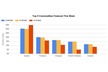
Subsidies are an engine which, for almost a decade, have not only driven the agricultural sector in Bulgaria, but also created artificial stimuli determining the direction of its development.
The Bulgarian Ministry of Agriculture and Food chose to change the way this tremendous lever was used for the 2014-2020 period and redirected money to priority industries: for example, fruits and vegetables. This has already yielded results. In 2015, fruit growing has recorded a 26% growth and vegetable growing has expanded by 17%. According to data from the Minister of Agriculture and Food, Desislava Taneva, this trend has continued in 2016, with a 52% increase in the acreage devoted to fruit and a 16% growth in greenhouse production. This increase is not associated only with the subsidies. Bulgaria has longstanding traditions and almost optimal conditions for the cultivation of some fruits and vegetables. The sector also has considerable export potential and works mainly for the processing industry, which exports products with high added value.
But Bulgaria's internal market for domestic vegetables and fruits is still unable to gain a lead over the Greek, Turkish, Polish, Italian and Macedonian production. The main reason is the lower prices of imports. According to Bulgarian growers, this is likely the result of higher production costs and inequality in the amount of subsidies granted to EU partners in the same market. Other problems are the large grey sector and lack of strong producer organisations able to supply large volumes with a homogeneous quality. Traders also have their reasons for dissatisfaction with Bulgarian producers, as the packaging and storage standards are very low.
Freshness at a low price
"Customers generally seek the lowest price; of course, there are those who prefer Bulgarian goods when they are in season, but prices remain the most important factor," said a trader of the stock exchange in Slatina. Even at this time of year, when the local production is harvested and trading is most active, prices of Bulgarian goods are significantly higher than those of imported products, according to official data from the State Commission on Commodity Exchanges and Wholesale Markets.
It is believed that the reason why Bulgarian products reach the end customer at a more expensive price is because of too many middlemen in the chain. In any case, Mr Vladimir Videnov, a vegetable trader, believes that there are still Bulgarian consumers who prefer to buy local fruits and vegetables because they think that they are better or they simply prefer a given local variety. Such customers, however, are not excluded from falling into the trap of unscrupulous traders who sell their Greek or Macedonian products as Bulgarian.
For Bulgarian products to become more competitive, growers will need to increase the effectiveness of their holdings. "The problem is not really that the fruit from neighbouring countries is very cheap, but that the Bulgarian one is very expensive, because of a lack of technology for the cultivation process. Over the last 20-30 years, we have been left behind and we are only now starting to catch up on the basis of trial and error, so our production costs are higher and this increases the price," said the President of the Union of Growers, Zhivka Grozdeva. "If we had science and institutes to tell us which varieties are suitable for Bulgaria, how to grow, how to obtain a good yield or how to reduce costs to sell at competitive prices, the picture would be very different. At the moment, for example, the price of Bulgarian apples is 100% higher than that of the Polish. There are rare cases where the local production has to be discarded because of limited export opportunities and/or because of their inability to compete with foreign products in the domestic market," she stated. According to her data on the fresh fruit market, only 20-30% of the supply is Bulgarian. Cherries are practically the only product which struggles to compete with the home-grown produce.
Competitiveness in the fruit and vegetable sector, according to the producers, is low because of the different ways of subsidising in different EU countries. "Poland and Greece have government strategies to support the development of some sectors, on top of the European subsidies," said Grozdeva.
Another of the main problems is that the holdings, for the most part, are small and unable to supply the volumes demanded by the market. Associations of producers, which can supply large quantities from the same varieties, have not yet been created. This restricts access to new and larger markets, but also has an impact on prices and on the negotiations with traders and suppliers.
But these are rather minor problems when looking at the huge grey sector in sales and imports, with around 80-85% of the products marketed without documents or the payment of duties, according to the National Union of Gardeners in Bulgaria (NSGB).
Source: capital.bg