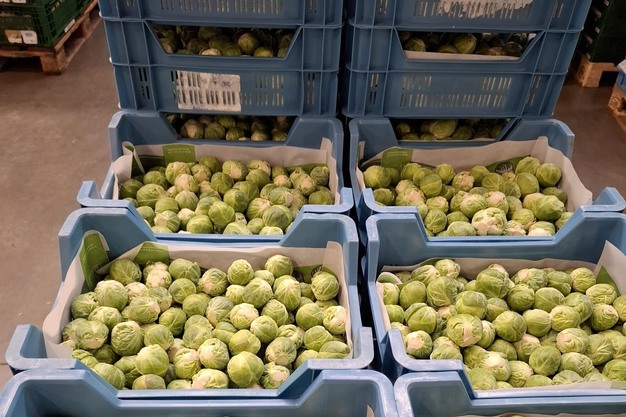
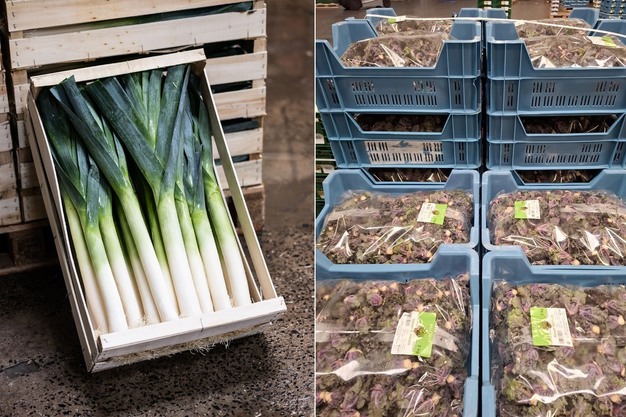
With the transition from summer to winter, FMB is shifting the focus of its assortment from greenhouse vegetables to outdoor vegetables and top fruit. However, the weather is not yet cooperating to boost the outdoor vegetable market. "This is a Europe-wide phenomenon for products like Brussels sprouts, cauliflower, and leeks. The harvest has been good everywhere, and there is more than enough supply. The demand just cannot keep up yet," says Jonathan Vandesande of FMB.
 © FMB
© FMB
"It is normally something that really takes off for us during this period, but everywhere there is plenty of produce. As a result, things are moving a bit slower. Unless a proper snowstorm passes over Europe, there won't be much change either," the trader explains. "Take hand-polished sprouts, for example. A true Belgian specialty, where the sprouts are not harvested by machine but cut manually with a knife. It's a beautiful premium product, but when you're getting prices of 50 to 80 euro cents per kilo or 2.50 to 4 euros per box, it's simply not worth it anymore."
"It's a painful reality right now, but if it doesn't freeze properly, prices will remain poor. It would be better for everyone if some of the volumes disappeared from the market. That's simply the economic truth. That said, a rise in consumption would also make a difference, of course. Next week, 18 degrees is predicted here in Belgium. That's obviously not sprout weather, so that could work against us too."
 © FMB
© FMB
Transition to Spain in greenhouse vegetables
Greenhouse vegetables are now taking a back seat at FMB during this period. "Belgian greenhouse vegetables are slowly coming to an end anyway. Some growers continue with outdoor cultivation of vine tomatoes and cucumbers, so those volumes remain. But these are not the quantities we see in summer. For tomatoes, I think we're at about 30 percent of the summer's levels. Peppers and aubergines are now completely finished. There are still a few last batches coming up at the auction, but that's from growers who haven't yet fully cleared out their greenhouses."
"Most traders switched to Spanish products a few weeks ago. The start was a bit slower than in other years, but I'm hearing a few problems now. Basically, everything from cucumbers and peppers to aubergines is available in good volumes. We continue supplying some Belgian vine tomatoes and cucumbers to Germany. As long as we have representative volumes, they sell well. People are willing to pay for them, so we'll keep doing that through the winter. Especially with specialities like cherry tomatoes, we can really stand out on quality compared to Italian or Spanish products. These are established through partnerships, and they continue to perform well."
 © FMB
© FMB
Small sizes of top fruit are in abundance
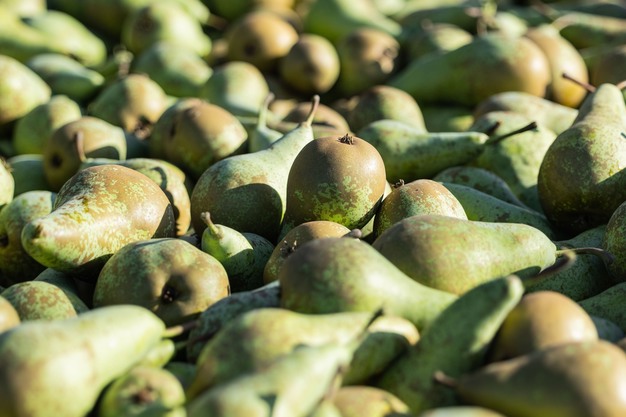
Things remain quiet in the top fruit market too, which the exporter mainly supplies to Germany during the winter period. "The past few weeks have been fine. There was a brief shortage because quite a few growers were on holiday during the autumn break and didn't do any sorting. It's always easier to work with a shortage than with oversupply, but now you can see that everyone is back. Volumes are increasing again, and prices have dropped a few cents at the auction."
"Especially in smaller sizes, there is no shortage at all in Germany," Jonathan explains. "You can sense that the top fruit season is really kicking off now. Apples and pears come out of storage at the beginning of November, and you immediately see there's more of everything than last year. That means prices are still much lower than last season. Regionally in Germany, there's also plenty of small apples and pears, so we see several traders and cooperatives struggling to move their products. It should be noted that demand isn't helping either. We'll have to see how things develop in the coming weeks. Some growers might sort less because they're unhappy with the prices. Still, I don't expect any major changes in the top fruit market anytime soon."
For more information:
Jonathan Vandesande
FMB
Kempenarestraat 50A - Bus 3
2860 Sint-Katelijne-Waver, Belgium
Tel: +32 15 560600
[email protected]
www.fmb.be