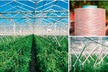
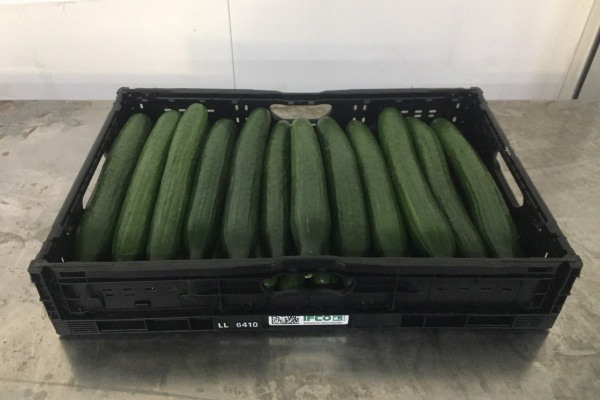
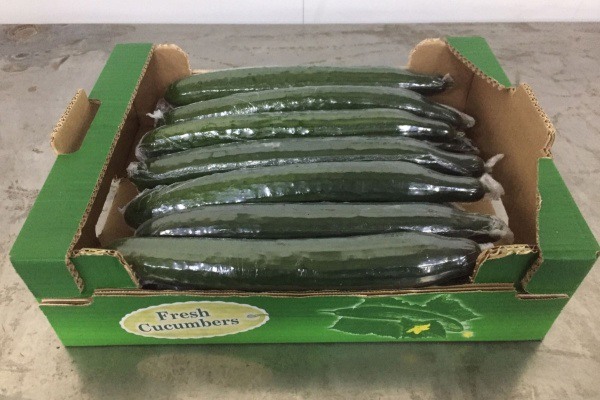
November is a pivotal month for the production of the long Cretan cucumber. "Cucumbers are the only crop currently traded by our company. At the moment, they represent the only truly exportable greenhouse product in Crete. The harvest of the current crop began around October 15th, and until November 15th, it will cover a limited acreage. The produce will be sourced from Tympaki, Antiskari, and Ierapetra. From that point on, the harvest will also begin in Arvi and Kastri, while it will reach its peak in early December," states Mr. Labros Pervolarakis, a Cretan packer and exporter.
 © L. Pervolarakis S.A.
As he stresses, market conditions have not been favorable for Cretan cucumbers so far: "The beginning was good, but this lasted only a few days. Then, demand fell considerably. Many factors act in combination. On the one hand, local cucumbers are really expensive. Current grower prices range from 0,90 to 1,60 euros per kg. On the other hand, the markets we supply already have quite good volumes of their own cultivated product, as well as Albanian, Turkish, and Spanish imports. We have to wait in line to sell, but this is normal for this time of the season."
"In Romania, we cannot export anything at all. Buyers there prefer the very cheap mini cucumbers coming from Turkey. Albania is at full production as well and sells at very attractive prices for Balkan importers. Albanian exporters deliver their cucumbers at the same prices we pay local growers. In the rest of Europe, i.e., Germany, northern European and Baltic countries, Spain dominates the market, sending large shipments of competitively priced products," clarifies the Greek exporter.
 © L. Pervolarakis S.A.
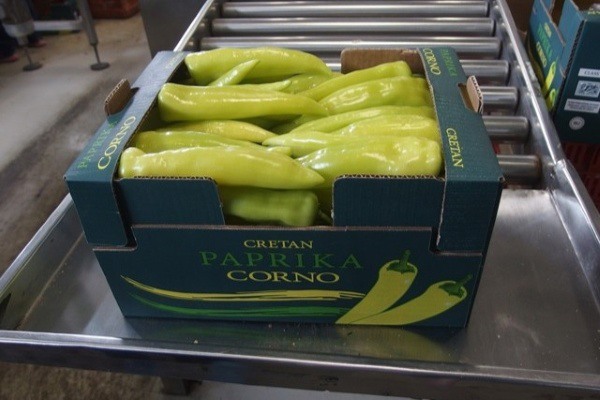
Another greenhouse product currently traded by Mr. Pervolarakis is horn peppers: "These days, we buy this vegetable from Ierapetra. Grower prices are low, at 0,75 euros per kg. However, this product does not move either. In this case, our big problem is the Moroccan white pepper, which is often nicknamed 'Hungarian'. Europe demands only these peppers. Before Morocco developed and began exporting them in large quantities to Europe, our company used to ship around 20 truckloads of peppers per week at this time of the season. Now, we send only one such shipment per week. Cretan growers tried cultivating this pepper, but it was yielding mostly second-category produce."
Finally, what permanently concerns Mr. Pervolarakis is the energy cost. "We have scheduled a renovation of our cooling generators to a more ecological and cost-efficient system. It was necessary. Since the beginning of the war in Ukraine, energy costs have skyrocketed by 110%," he concludes.
 © L. Pervolarakis S.A.
For more information:
Labros Pervolarakis
L. Pervolarakis S.A.
Tel: +30 2810 871 536, +30 2810 871 435
Email: [email protected]