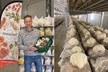
"The pumpkin season is going very well so far," says Jeroen De Ridder of the eponymous farm in Sint-Gillis-Waas. Even though bottle pumpkins are now available on shelves year-round, the grey October weather and the upcoming holidays always trigger a surge in demand. "Demand has really doubled over the past two weeks," he says.
Jeroen, whose company proudly carries the nickname Jeroen Pompoen, says there's little to complain about this year's harvest. "We've had strong production, and even the sizes of the pumpkins are quite good. Despite the drought, that's surprisingly positive. Pumpkins may benefit from somewhat drier summers, but too much dryness can be disastrous. Luckily, we haven't suffered any major setbacks, so we can't complain. Compared to last year, yields are even slightly above average for both the Hokkaido and bottle pumpkins."

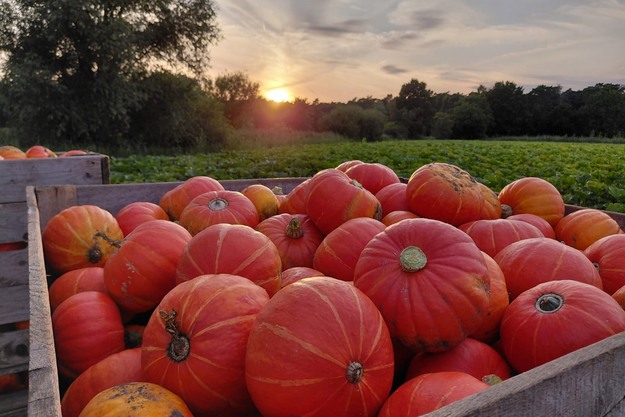
"The pumpkins were harvested under good conditions, and everything is now in storage," continues the grower, who cultivates 10 different varieties across about 74 hectares. The main ones are Hokkaido and bottle pumpkins, but Jeroen is also experimenting with several other types on a special trial plot. "We started bringing in the first pumpkins as early as 10 September, and the field harvest was fully completed by 15 October," he says. So far, the storage conditions look good, although it's still a bit early to make a final judgment. "For now, we have enough kilos and, of course, we're hoping for strong sales so that everything actually gets sold."
Export toward the end of the season
Sales are currently 95% focused on the Belgian market, and demand is now picking up. "In Belgium, we've been supplying supermarkets since the beginning of September, but as mentioned, demand has really doubled in the past two weeks. It always starts rising toward the end of September. Storage is good, so we expect quality to remain consistent through the New Year. That's exceptionally positive this year because last season we had lower yields and more quality issues due to the wet weather."
"Exports haven't really taken off yet," he continues. "There have been some price enquiries, but they haven't led to actual orders so far. It might just be a bit early in the season. I do suspect we'll soon need exports to move all our volumes. In Belgium, bottle pumpkins are sold year-round and remain stable until April, but Hokkaido pumpkins typically disappear from shelves within two to three weeks after the New Year. In neighbouring countries, pumpkins are available for longer, but here they fade quickly. That's when exports become necessary toward the end of the year."
 © Jeroen Pompoen
"Every year, we notice the October craze. We don't really focus on it as a company, but demand always returns. Some individuals are willing to pay hefty sums for ornamental pumpkins just for a photoshoot with their baby. You see people drive 150 kilometres and pay €10 to €14 for a single pumpkin without hesitation. That's a completely different market from consumption; it's all about the experience. After 1 November, demand vanishes entirely. If you still have a lot, then you're stuck with them. But maybe it's time we also start benefiting from this trend."
Fresh-pack concept yet to catch on in Belgium
The Flemish grower, a member of Coöperatie Hoogstraten, also observes a steady rise in overall pumpkin consumption. "You can see that people are cooking more with pumpkin. More recipes appear every year, and demand continues to grow slightly. Customers with whom we fix seasonal volumes also confirm that the market is still expanding. In the Netherlands, you see a lot of fresh packs with pumpkin in supermarkets, but in Belgium, that concept is still less popular. It is increasing slightly each year, though. Convenience customers, in particular, are buying more, and this year we saw about a 10% rise in that segment. But the real 'fresh-pack concepts', like in the Netherlands, are still uncommon here. That's not just true for pumpkins but for the entire concept."
 © Jeroen Pompoen
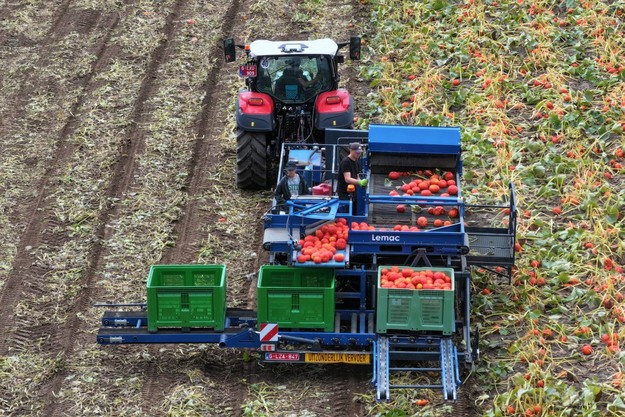
Perhaps the biggest challenge in pumpkin cultivation remains staffing, Jeroen confirms. "Extreme weather conditions are, of course, something we must learn to handle, but finding good staff is an even greater challenge. Automation is part of the solution. We continue to invest in sorting capacity and constantly look for ways to do more with fewer people. Wherever possible, we aim to reduce manual labour. That's essential for the future."
"Mechanisation remains a particular challenge for bottle pumpkins. For other pumpkin varieties, machine harvesting works fine, but with bottle pumpkins, the stem is too hard and easily damaged, making automatic harvesting difficult. We're now testing techniques where we manually cut the pumpkin loose and then automatically place it in crates to ease the workload. But butternut remains a tricky variety to harvest efficiently. That's why we're not expanding that crop for now. I think many growers are waiting for a good solution, but I fear we'll have to be patient a little longer."
For more information:
Jeroen De Ridder
Jeroen Pompoen  Heerweg 3
9170 Sint - Pauwels, Belgium
Tel: +32 (0)484 73 86 64
[email protected]
www.jeroenpompoen.be