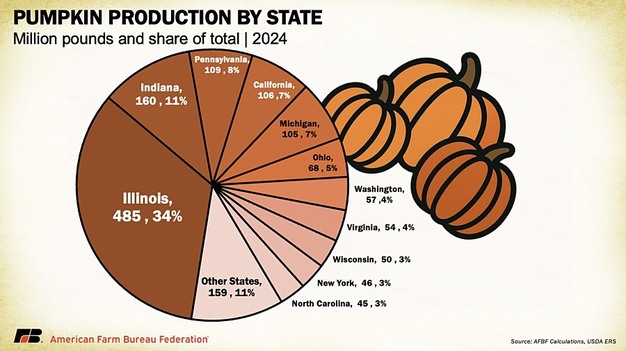
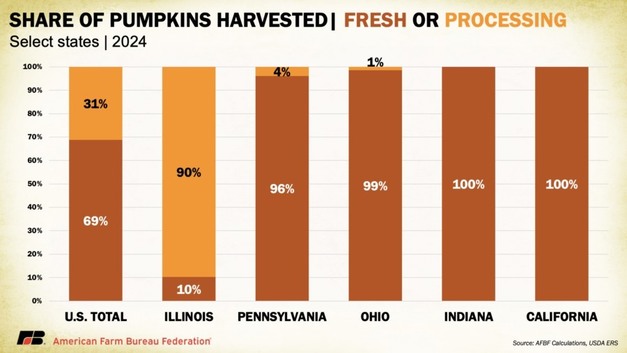
Pumpkins remain an important specialty crop in the United States, with growing demand for both fresh and processed use. In 2024, pumpkins were grown on more than 27,500 hectares, producing about 635 million kilograms. Production is concentrated in Illinois, Indiana, Pennsylvania, California, and Michigan, which together account for about two-thirds of the total. Illinois alone harvested 6,200 hectares and produced 220 million kilograms, mostly for processing. Around 90% of Illinois's crop is used for pie filling and canned products, mainly supplied to Libby's.
 © American Farm Bureau Federation
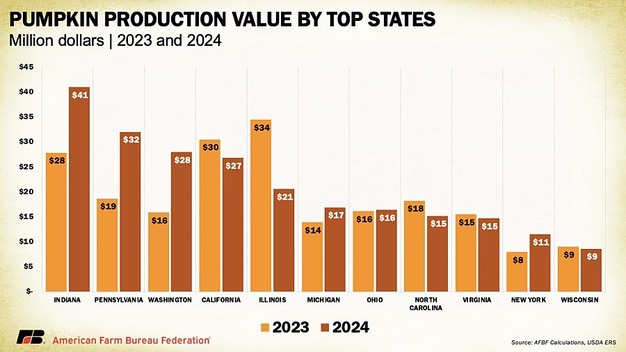
Yields vary across regions, with Illinois averaging 31,500 kilograms per hectare in 2024 and Pennsylvania about 16,000 kilograms. The total farm value of production reached US$274 million. Illinois led in volume but generated US$21 million because of lower processing prices, while Indiana earned US$40 million, Pennsylvania US$32 million, and Washington US$28 million. Prices ranged from about US$50 per 1,000 kilograms (US$0.05 per kilogram) for processing pumpkins to US$324 per 1,000 kilograms (US$0.32 per kilogram) for fresh pumpkins. Retail prices averaged US$6.21 per large pumpkin, with wholesale bins selling at about US$157 for carving types, US$212 for pie pumpkins, and US$350 for heirloom varieties.
The U.S. exported US$26.3 million worth of pumpkins in 2024, mainly to Canada (US$21.8 million) and Mexico (US$3.3 million), while imports totaled US$21.7 million, largely from Canada, Costa Rica, and Panama. Exports of pumpkin seeds reached US$3.8 million, with Canada, Germany, and the United Kingdom as key destinations.
 © American Farm Bureau Federation
Pumpkins are planted in late spring and harvested before autumn. Per capita consumption has risen to 5–6 kilograms annually. Growers face challenges from high labor and input costs, limited insurance access, and variable weather. Drought, excess rainfall, and frost can all reduce yields. Pests such as vine borers and cucumber beetles, and diseases like powdery mildew, remain persistent threats. Many farmers now use hybrid seeds bred for disease resistance despite higher costs.
Ornamental pumpkins are hand-picked to preserve stems, creating short-term labor demand. Processing pumpkins is mechanically harvested, reducing labor but requiring investment in equipment. The perishable nature of the crop adds further logistical challenges in post-harvest handling and transport.
Crop insurance options have expanded slightly. The USDA's Risk Management Agency recently made Processing Pumpkin coverage permanent in Illinois, starting in 2025. This allows insured yields up to 85% of historical averages for pumpkins grown under processor contracts. Most other growers rely on the USDA's Noninsured Crop Disaster Assistance Program (NAP), which offers limited compensation for yield losses above 50%.
 © American Farm Bureau Federation
In 2024, about 2,870 hectares of pumpkins valued at US$5.6 million were insured nationwide. Federal data show 56% of acreage uninsured, 31% insured under NAP, and 13% under federal crop insurance. Many producers rely instead on diversification, staggered planting, and precise harvest timing to reduce risk.
 © American Farm Bureau FederationFor more information:
American Farm Bureau Federation
Tel: +1 202 406 3600
Email: [email protected]
www.fb.org