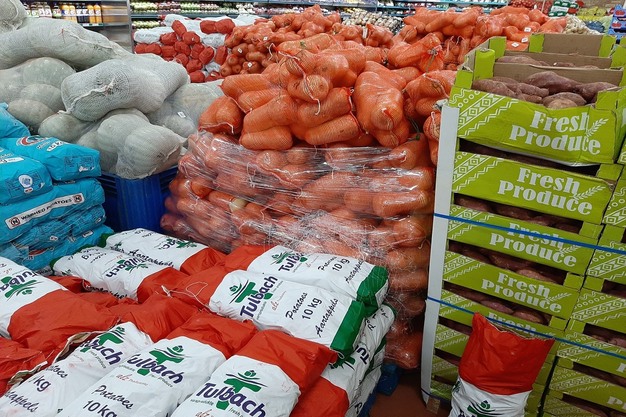
Great growing conditions and few setbacks have resulted in bumper crops and an oversupply in many (not all) vegetables. Retailers are continuously running promotions, but it's a battle, says a fresh produce manager at a retailer. "We have to shift 100% of our kilograms to get to last year's turnover. You only have to look at the deflation in vegetable prices to know it's been a mild winter."
Economist at the National Agricultural Marketing Council, Thabile Nkunjana, confirms that almost all key vegetables have experienced a rate of deflation of on average 11% in October, due to an oversupply. "In early October, the price of 10 kgs was close to 70 per cent lower year-on-year," he says. "Onions were around 10 per cent lower, cabbage at around 50 percent."
 © Carolize Jansen | FreshPlaza.com
Tomatoes skyrocketed as result of Namibian import suspension
Beetroot was an exception and has had a challenging season, he says, because of heavy rain in April, and it is one of the few vegetables more expensive on a year-on-year basis. It was also affected by the closure of a beetroot processing plant and a consequent reduction in plantings as some vegetable growers replaced beetroot with potatoes.
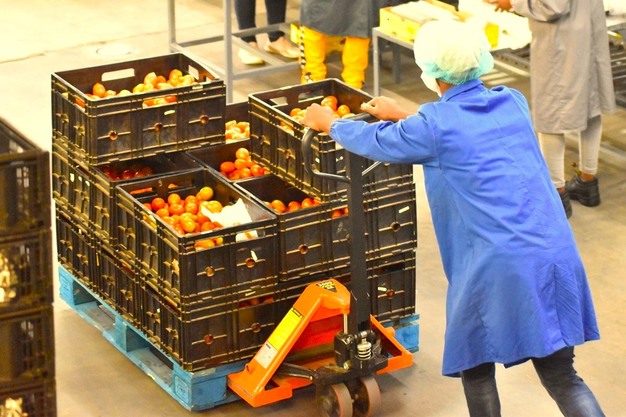
Tomatoes are another exception to the deflationary trend. Tomatoes have become 70% more expensive since the suspension of Namibian tomato imports, he says, coupled with a decline in South Africa's local production, where disease has had a big impact.
"Tomato is such a delicate and complicated crop. Around the period where we would normally be getting tomatoes from Namibia, as a result of the ban, we've seen that prices for tomatoes skyrocketed," he says. "Namibia is such a large supplier of our tomatoes when we're having local supply issues. That really pushed prices to a very high level around October."
Butternuts and pumpkins are also currently in the boom phase of their boom-and-bust cycle: 2023's excellent prices attracted new entrants, resulting in low prices last year and a shrinkage in production. Therefore, currently butternut and pumpkin prices are again high at R15 (€0.75) to R25 (€1.25) per kilogram.
 © Carolize Jansen | FreshPlaza.com
Deflationary prices benefit consumers across the border
The current deflation in vegetable prices in South Africa has benefited consumers in Botswana too. "Vegetable prices were some of the key drivers of inflation in Botswana, especially in 2024, but over the last few months, prices have stabilised a little bit, and of course, consumers can be able to get these very affordable products, reversing inflation."
This is another example of how deeply integrated the region is, Nkunjana observes. The one thing that you don't want is the closure of any borders, he says, especially among the Southern African Customs Union countries that are very close to one another because there's so much difference between them in terms of production and capacity, but periodic closures have become part of the intra-Southern African trade playbook.
"Around 2021, Botswana and Namibia started banning specific South African vegetable product imports to help their own farmers," he says. Both countries had a comparatively high share of their vegetables coming from South Africa amid insufficient domestic production. Botswana accounted for 15% of South Africa's US$224.3 million worth of vegetable exports.
Botswana has gradually reduced its ban since then, he says, with the last limitations eliminated in April 2025. Due to the embargo, the percentage of South African vegetables on Botswana's shelves dropped to 7% in 2022, suggesting, he says, that the import share of South African vegetables was reduced by 50%.
Namibia's bans remain in place.
There is a provision within the World Trade Organisation for the protection of domestic industries in the striving towards nutritional self-sufficiency, but it must be done in a manner that doesn't affect others. He refers to Botswana's decision to close its border to South African cucumbers, effective four days from announcement in April 2024, incensing farmers who'd reckoned on that market. "However, trade is fine now that the restriction has been lifted in two stages, which benefits both Botswana's consumers and South Africa's farmers."
Do the import bans indeed nurture domestic production? Trade restrictions have had unintended repercussions because of their ambiguous application, he says, even if they are sometimes effective and the product of good intentions.
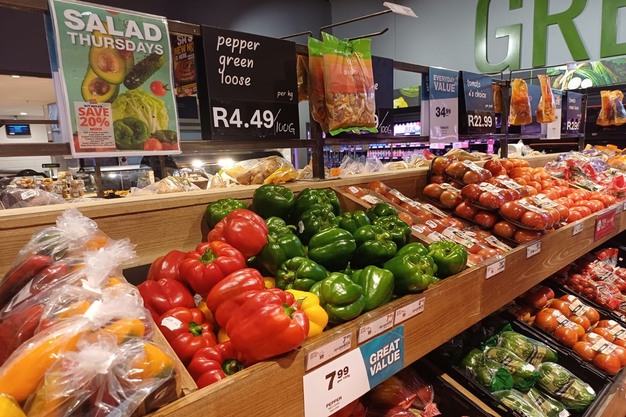 © Carolize Jansen | FreshPlaza.comSouth African retailers are running many fresh promotions at the moment
14% year-over-year rise in South African veg exports
Mozambique and Zimbabwe, on the other hand, have increased the vegetable imports, and it is important to note, Nkunjana adds, that South African vegetable exports to countries outside of Southern Africa have somewhat increased since the bans. "For example, the Netherlands increased its imports of vegetables from South Africa by 20% from US$11.5 million in 2019 to US$20.4 million in 2024, indicating that some quantities are being supplied to the wider EU market."
Due to all these changes, he observes, South Africa's vegetable exports went from US$190.4 million in 2023 to US$218.0 million in 2024, a 14% year-over-year rise.
Competition is healthy, he maintains, and it's what helped the South African beef industry to become more efficient, forced to hold its own against the Namibian and Botswana beef industries.
For more information: Thabile Nkunjana
National Agricultural Marketing Council
Tel: +27 12 341 1115
Email: [email protected]
https://www.namc.co.za/